This text was submitted to The World Transformed 2025 festival’s assemblies by Kojo Kyerewaa, Black Lives Matter UK National Organiser.
I’d like to start with a thought-experiment, a “pre-mortem”. Let’s project ourselves to July 2029. The general election has happened, and the electorate has delivered a devastating verdict.
The Labour Party led by Shabana Mahmood has suffered a historic defeat, a British Pasokification, collapsing from a ruling party elected with over 400 seats to shedding almost 300 MPs, now having less than 90 seats. Reform won but not enough to win an outright majority and so it has struck a deal with Conservatives led by Robert Jenrick. Farage will be Prime Minister with Jenrick as Justice Secretary. They have agreed to phase out indefinite leave to remain status, including retrospectively by the end of the parliament, which would affect over 400,000 residents. Britain will leave the European Court of Human Rights in order to implement a radical deportation policy, restrict judicial reviews on new legislation, and also privatise the remnants of the Welfare State to “unleash” Britain’s potential. On the plus side, Your Party won 30 seats and is larger than the Greens with 20 seats.
How did this happen? And more importantly, how do we prevent a Farage Premiership?
Perhaps we lost because we relied on social media rather than developing social infrastructure to organise our base.
Perhaps we lost because the far-right had a 20 year head-start and we took 4 years merely learning how to relate to one another.
Perhaps we lost because we collectively failed to cohere a compelling narrative on why our economy should be based on solidarity and care rather than competition and profit.
This is speculation, but it is not inevitable. It forces a sober assessment of the task before us. Even if we retained 90% of 700,000 people who have registered interest, the reality is that collectively we don’t have the experience, resources or structures to turn that supporter base into an electoral plurality of 10 million votes. This is a mammoth, historically unprecedented task.
In theory it could be done in 4 years but if it doesn’t we should not lose heart. But if it isn’t, we must not lose heart. We cannot allow a Farage premiership to shatter our resolve. We need to be steadfast in our long-term goals and not allow short-term setbacks to sabotage our long-term strategy for socialist transformation.
Steadfastness in bleak times
Our comrades in Italy have executed a general strike in favour of Palestine under a
far-right government, in Bangladesh and recently Nepal – a long-ruling party was toppled by protest. In Kenya, IMF policies are struggling against sustained mass resistance.
Friends, our class has faced worse than Farage. If our predecessors could overturn formal colonial rule, end imperial wars and genocide then so can we. But nothing is promised. We have seen how Your Party, riding high in the polls, can be plunged into internal strife and lose public confidence overnight. Anything is possible—for better or for worse.
This underscores a vital lesson: our internal culture is a strategic priority. We have learned that collective discipline and a generosity of spirit towards our comrades, especially in moments of acute frustration, are not optional. How we relate to each other is as important as the ideals we espouse. To build socialism, we must be social, practicing the good social relations we preach. In short and to endorse the Carefull Economy paper by Hannah Webster and Ruth Hannan, we cannot succeed without centring care and intention.
This paper calls for prioritising quality over quantity, strength over speed, steadfastness over superficial wins.
Power through people-led movements not politicians
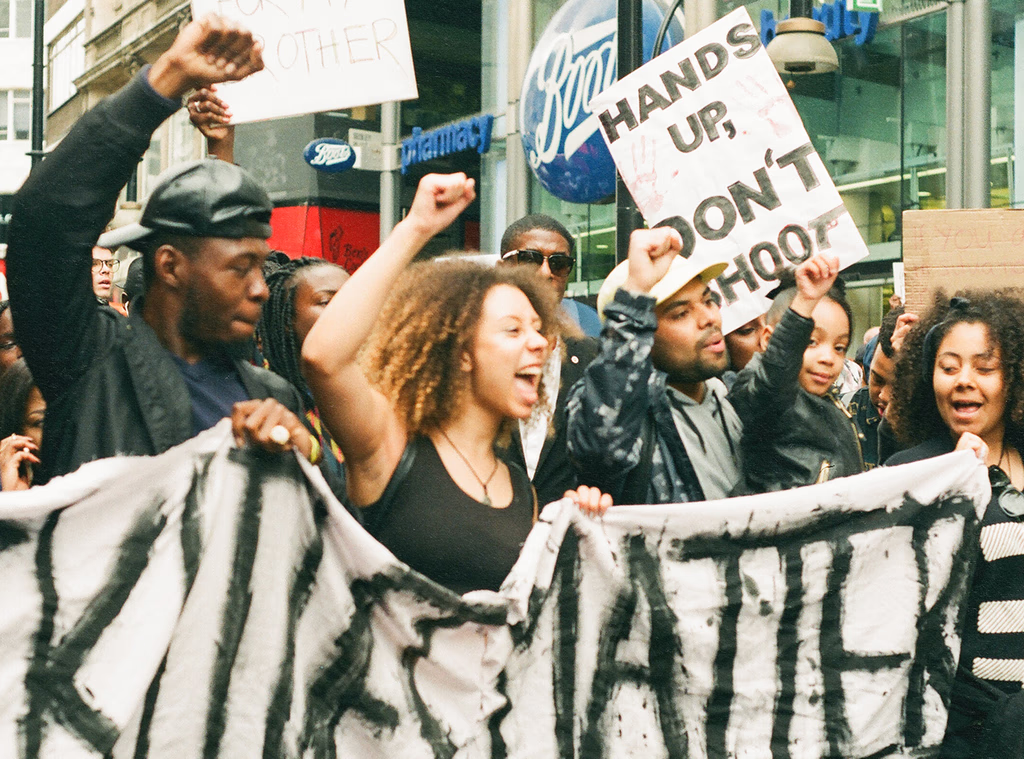
Large mobilisations whether they were the BLM protests of 2020, or the 100,000 strong march for Tommy Robinson, may boost confidence, but they alone do not sustain movements. To quote the Pan-Africanist thinker and radical organiser, Kwame Ture, “We want power… and power comes only from the organised masses”
Our ability to mobilise is not the real test of our collective power. The structural tests we must answer is how many active people are organising for power in our communities. This is why I endorse the Organising for Popular Power tendency. The organisation Momentum was a large force with incredible potential that largely became a Get-The-Vote-Out machine. Knocking doors is great but if people don’t believe that power and transformation is within their grasp then it doesn’t matter how many doors we knock.
Therefore, we must break out of our comfort zones. Relating to people by starting with abstract questions, as one paper suggests, does not speak to millions of people on Universal Credit and contending with punitive conditionalities right now. We need imagination, but we must also confront the immediate question of power. The 4 million children who are not getting 3 meals a day need bread, the question they are asking us is “how are we going to help them right now?”. Comrades, we must use our collective resources to develop social infrastructure and offer relief immediately, not ask people to wait until after an anointed few of us enter office.
Non-politicised people are rightly skeptical of promises and warm words. Corbyn’s reputation is brandished by action, the real material solidarity, casework and campaigns he has famously championed over 40 years. I suggest that if we are going to gain similar successes then we need to not only think about party culture and discussions but how we
organise power in our local communities without being elected politicians.
This is the core of my argument: we need an effective, democratic, and pluralist electoral party, but we first need a social movement that reaches a wider audience than those who believe the electoral system will save us. If we organise with the narrow horizon that electoral victory in 2029 is our immediate goal – we risk crippling disillusionment, disorientation and disorganisation when we inevitably fall short.
To make it plain: an effective electoral party is not an alternative to a social movement; it is its disciplined, political expression. Its role is not to lead the movement from above, but to articulate its demands in the political sphere, defend its gains in parliament, and use its platform to amplify the struggles on the ground. Without the movement, the party becomes an empty shell. Without the party, the movement lacks a crucial lever of state power.
Creating a mosaic of movements
So, what does this social movement look like? It is a mosaic of campaigns and struggles, linked together. It has the single focus: changing everything that touches our lives into something we collectively control. Most people under 40 do not engage with electoral politics, so this movement should encourage people not engaged in political parties or even different ones to be focused on what affects them now and what non-electoral power they have to change things. In this way, electoralism becomes a genuine tool for our class, not a destination in itself.
A social movement towards ending poverty and state violence irrespective of background, identity and status is easier said than done. I won’t pretend that BLMUK or anyone else has a perfect solution. There are some historical examples that we can draw from, there are also some contemporary groups that many at this festival represent.
We can learn from successful social movements, whether it is the US Student Non-violent committee which ended segregation, anti-colonial movements that toppled British and other European empires, to the Chartists and trade unions that won social innovations such as the weekend and the 8-hour working day. They shared at least three identifiable features: the 3 Rs.
1. Relief
They did not just campaign; they offered material and emotional relief. To go on strike, they organised food for striking workers and families. To ensure the Bristol Bus Boycott succeeded, they organised alternative transport. Any social movement worth its salt must think through sustaining people in struggle. It is not enough to have the right arguments; we must organise to care for people as a prefiguration of the society we want to build. This means our branches must become hubs of mutual aid—organising community fridges, solidarity networks to challenge benefit sanctions, evictions and immigration raids; and warm banks that double as political education spaces.
2. Repair
By developing structures of relief in struggle, we also repair social solidarity and our collective strength. Our communities are fragmented by imposed scarcity and state narratives that promote a hierarchy of human worth. We must consciously repair
this, not with rhetoric, but by caring for all without means-testing, as exemplified by Lesbian and Gays Support the Miners. I’ve seen this repair broken solidarity at the 2011 mass eviction resistance at the Traveller site – Dale Farm in Essex. By practicing this radical inclusivity, we break down racist, gendered, and ableist prejudices that divide our class.
3. Restructure
As we repair working class solidarity across regions and identities, we must not recreate the old colonial patterns. By centering care, cooperation, and mutual aid, we restructure ourselves and our social reality. This restructure is guided by our ideas and our praxis. As we struggle with the daily work of building a movement, we produce new knowledge and new ways of being that sustain us to a new future. This is how empires fell, this is what our ancestors from those who abolished enslavement and the limited electoral franchise teach us.
***
The challenge, of course, is weaving this mosaic of local campaigns into a unified national force. This requires intentional, democratic structures—federations of tenants’ unions, networks of community organisers, and a political party accountable to these grassroots formations—that can coordinate strategy, share resources, and articulate a common vision. Black Lives Matter UK is ready to play its part by developing a new national anti-racist network and participating in the new Organising for People Power Tendency.
This paper does not come up with a blueprint or a single answer to solve the key issues before us. It poses a series of questions:
How do we build a social movement that acts on the collective desires and hopes of those who have no to little faith in electoral politics?
How do we collectively demonstrate that by organising together, we can change the lives and conditions of the multicultural working class in the here and now?
How do set the conditions for effective and life-changing resistance to the state violence that we face now and that is to come under a possible Farage-Jenrick government?
By preparing for the worst, we may actually build our best chance of radical social transformation. BLMUK doesn’t have all the answers, but I hope by presenting this to you, we can find them together.
Leave a Reply